
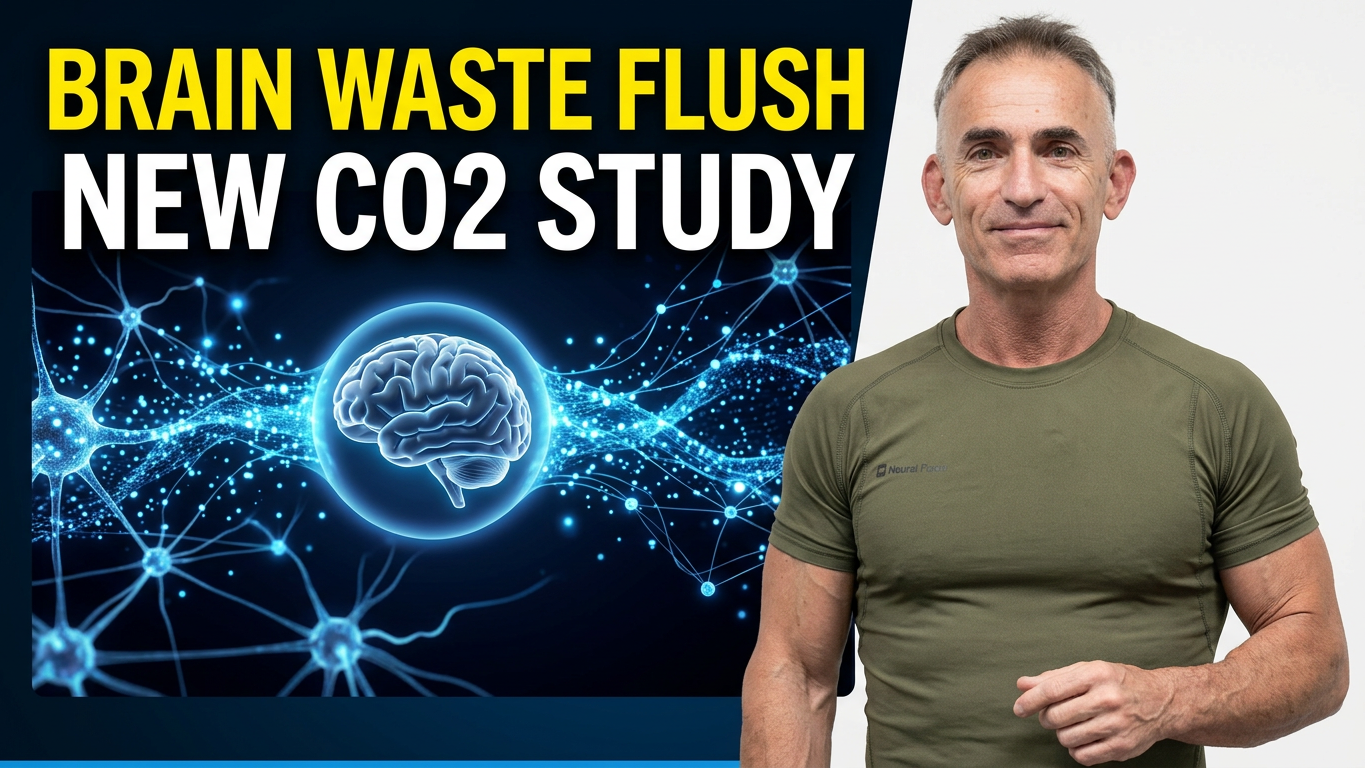
About This Episode In Episode 1305 of VHFILM, we explore a groundbreaking approach to neurological health: The CO2 Brain-Flush. While Carbon Dioxide is often viewed merely as a waste product, emerging research into Intermittent Hypercapnia suggests that controlled, brief increases in CO2 levels can act as a powerful biological “rinse” for the brain. This process triggers significant vasodilation, increasing cerebral blood flow and activating the glymphatic system to flush out metabolic toxins and proteins like beta-amyloid that are linked to cognitive decline. Join us as we break down the latest 2026 clinical data, the physiological mechanisms at play, and what this means for the future of biohacking and longevity.
Key Chapters
0:00 – The Hidden Power of CO2: An Introduction
0:45 – Understanding the Glymphatic System & Brain Waste
1:52 – What is Intermittent Hypercapnia? Defining the Protocol
3:28 – Cerebral Vasodilation: How CO2 Opens the “Floodgates”
5:10 – The “Brain-Flush” Mechanism: Step-by-Step Breakdown
7:05 – Clearing Beta-Amyloid & Tau: Clinical Evidence (2026 Update)
9:15 – Cognitive Benefits: Memory, Focus, and Neural Plasticity
10:45 – Safety First: Who Should (and Shouldn’t) Try This?
11:55 – Practical Methods: From Breathwork to Targeted Hypercapnia
12:40 – Summary: The Future of Neuro-Restorative Science
13:08 – Conclusion & Next Steps for Your Brain Health
Connect & Support If you found this scientific breakdown helpful, please like, subscribe, and hit the notification bell to stay updated on the latest in health science and longevity research.
#VHFILM #BrainHealth #Neuroscience #CO2BrainFlush #Biohacking #IntermittentHypercapnia #CognitiveLongevity #GlymphaticSystem #HealthOptimization #BrainDetox #ScienceUpdate2026 #Neuroplasticity
Formal Citation
Erhardt, E.B., Mayer, A.R., Lin, H.C., Pirio Richardson, S.E., Shaf, N.A., Vakhtin, A.A., Caprihan, A., van der Horn, H.J., Hoffman, N., Phillips, J.P., Grigg-Damberger, M., Wang, C.H., Gough, J., Hobson, S., Deligtisch, A., Suarez Cedeno, G., Sugar, D., & Ryman, S.G. (2025). The influence of intermittent hypercapnia on cerebrospinal fluid flow and clearance in Parkinson’s disease and healthy older adults. npj Parkinson’s Disease, 11, Article 334. https://doi.org/10.1038/s41531-025-01…
⚠️ IMPORTANT SAFETY NOTICE: The procedures shown in this video were conducted in a strictly controlled medical environment under professional supervision. Do not attempt to replicate these methods on your own (such as using paper bags or restricted breathing), as improper application can lead to hypoxia, loss of consciousness, or other serious health risks.
intermittent hypercapnia, glymphatic system clearance, Parkinson disease CSF flow, alpha-synuclein brain clearance, neurodegenerative waste removal, Alzheimer disease co-pathology, blood oxygen level dependent MRI, cerebrovascular reactivity, end tidal CO2 monitoring, vasomotion driven CSF influx, tau protein clearance, neurofilament light chain biomarkers, GFAP blood biomarkers, brain detoxification mechanisms, slow wave sleep glymphatic function, non-pharmacological neuroprotection, neurofluid coupling, fourth ventricle CSF inflow, carbon dioxide vascular response, human brain waste clearance, parkinsons disease research 2025, rhythmic vasomotion therapy, blood brain barrier integrity, neurodegeneration treatment strategies, systemic protein efflux
How this was made